Posts

Wearing the Cross

Image
Last weekend, there was a bit of discussion around wearing the cross as a public demonstration of Christian faith. Cardinal Keith O'Brien suggests  Christians should openly wear a cross as a symbol of their belief. Giles Fraser , however perfers the empty tomb as a symbol (interesting - what would an empty tomb lapel badge look like?). For him, the cross is a symbol of torture and the domestication of Christianity to empire. To my mind, both miss the point about the way the cross works as a Christian symbol. Originally it was pagans who mocked Christians with the accusation that their leader had been executed on a cross - a form of execution reserved mainly for slaves and criminals - those to be humiliated. The cross was the asymbol of defeat and shame with which Christians were taunted. And yet before long, those very Christians turned the accusation on its head by decorating their churches and signing themselves with the cross with a delicious touch ...

A Big Christianity - beyond Cameron and Chaos

Image
It’s taken me a while, but I’ve been thinking a bit about David Cameron’s recent foray into religion. It received a bit of a mixed reaction from all sides, including the usual rants from the atheists, but also perhaps a surprisingly lukewarm response from Christian voices. Some liked his reminder of our Christian heritage, some thought it was unrealistic given the levels of secularism we now have, some felt his vision of Christianity was too moralistic. I also read a piece by George Monbiot recently in the Guardian about what he called “The great political conflict of our age – between neocons and the millionaires and corporations they support on one side, and social justice campaigners and environmentalists on the other. ” and a lightbulb went on in my mind connecting the two pieces. David Cameron’s version of Christian faith is one of standards, morality, maintaining order and uprightnesss. It is typical of a more right-of-centre appreciation of religion for bringing order an...

Sepp Blatter and the Judgment of God

Image
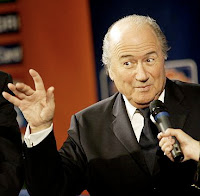
Sepp Blatter has done it again. Switzerland's most famous buffoon has managed to alienate most of the human race with his comments about racial abuse in football. According to our beloved head of FIFA, you can get abused for the colour of your skin all game and are then you're meant to shake hands and forget it as if it really doesn't matter. But it does. And we know it does and it isn't good enough to pretend that it doesn't and can just be let go. The public outrage shows our sense of injustice and the desire for judgement - that when something has been done that is fundamentally wrong, it needs to be dealt with properly, not brushed under the carpet. One charge often made against Christian faith is that the doctrine of divine judgement is exclusive and violent. The idea that God should judge is deemed harsh and unacceptable. Instead, the idea of 'indiscriminate hospitality' is supposed to be more worthy of God, who should accept everyone, with no qu...

Prayer alone conquers God

Image
If you ever wonder whether it is worthwhile praying, and whether it makes any difference, here is a bit of early Christian theology that might help. Tertullian was a Latin-speaking theologian of the C2nd with an ear for a good phrase and a great delight in shocking people. How about this:   " Prayer alone conquers God. But Christ has no desire that it should do any evil deed; he has conferred upon it every power of doing good. Therefore it knows only how to call back the souls of the departed from the journey of death itself, to strengthen the weak, to restore the sick, to cleanse the possessed, to open the doors of prison, to loosen the chains for the innocent. The same prayer absolves sins, repels temptations, puts down persecutions, strengthens the weak-hearted, delights the high-minded, leads wanderers home, soothes the waves, confounds robbers, feeds the poor, governs the rich, lifts up the fallen, supports the unsteady, holds firm those who stand. Pray...

St Paul's, Occupy London and the need for Repentance

Image
The Christian church has always insisted on the necessity, every now and again, of repentance. Week after week in churches around the world, people are invited to admit their failings and sins out loud before everyone else in words of confession. It is remarkable when you think of it and not a little counter-cultural, to publicly express the fact that you are sorry for what you have done. After all in a culture always eager to find someone to accuse, who wants to stick their head above the parapet and invite the accusing finger of blame? So usually the default position of most of us (not just politicians) is to find someone else whose fault it is, and whatever you do, don’t admit liability. Thinking about the strange saga of St Paul’s, it seems to me that the whole thing demands some real repentance as the key to moving on, and that in two ways. I must admit on first sight, I shared some of the misgivings of the St Paul’s Clergy Chapter. If I were the Dean of St Paul’s, would...

Leisure: what we are here for

Image
On holiday in France a couple of weeks ago, we wandered into an old, but still functioning monastery. In the gift shop I saw a book by the German Catholic philosopher, Josef Pieper, called 'Le Loisir: La Fondation de la Culture'. I had read one or two of his works before, and this looked to be a promising title for a holiday, so I quickly ordered the English translation (Leisure: the Basis of Culture), and have been reading it for the past couple of days. A lot of us think of holidays as a necessary break to re-charge our batteries, so we can shed our jaded end-of-year weariness and return to work refreshed and ready to go again. The problem with this view of things is that it assumes that 'work' is what we are here for, and leisure is secondary, something which only prepares us for more work. Holidays are there to stop us having breakdowns, and are good because they help make us better workers. We are really here to work, to labour and to produce. What if it is th...

Love and Death

Image
This weekend, I went to two weddings and one funeral. A real mix of emotions and a chance to contemplate significant moments in the lives of several different people. The funeral came first, a farewell to Gerald Hegarty, a former fellow-staff member at Wycliffe Hall in Oxford, and a wonderfully gentle, humble, wise, incisive and warm man. Two weddings came next, of Lincoln Harvey, one of my colleagues at St Mellitus, marrying Tereza, and my godson Barney Morgan, marrying Josie Cooley. Both of them full of genuine fun, solemnity and happiness. It got me thinking about the extremes of joy and grief, happiness and sadness right next to each other. What struck me was the setting of all three events - in Christian worship. In all three we said the Lord's Prayer, offered thanksgiving, sung to God and each other, remembered the gospel promises. The big moments of our lives - birth, love, death, need a kind of 'frame' to give them shape and structure. Christian faith was ...